
Memory Care
Memory Care Activities: A Family's Guide
Memory care activities can support choice and connection. Learn how to assess daily engagement, activity adaptations, and questions to ask during a tour.
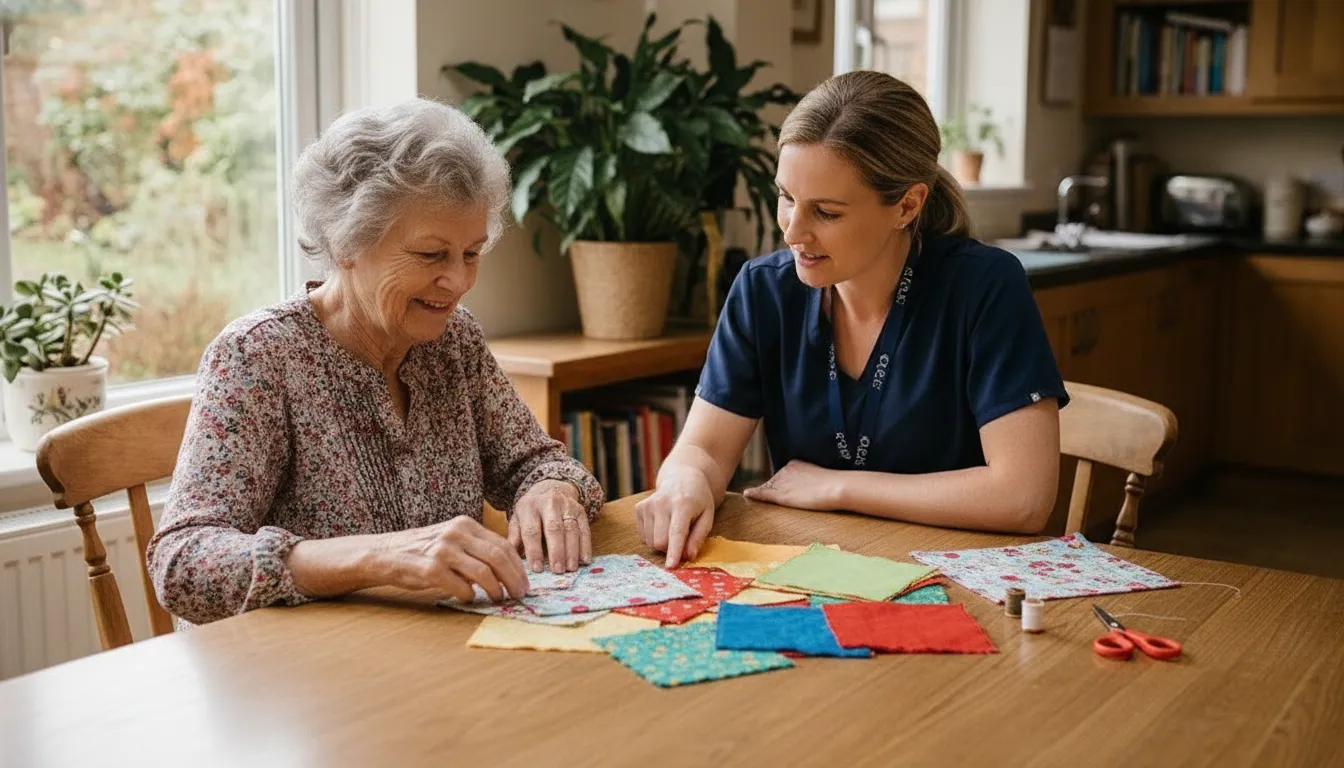
Memory care activities can be important to families comparing programs. A full calendar may look reassuring, but event counts do not show whether your relative feels involved or comfortable. On a tour, notice whether staff offer choices and shape activities around familiar interests.
Compare memory care options and prepare focused activity questions
Meaningful memory care activities help a person stay involved in daily life and relationships. Options should reflect the person's preferences and current abilities. Families can ask how staff offer choices, adapt support, and respond to comfort or interest.
The difference is easier to assess when you consider what gives an activity meaning to this person, not just whether it appears on the calendar.
Why meaningful memory care activities matter more than a busy calendar
A full schedule can look reassuring on paper, but event counts do not show whether activities feel worthwhile. Ask whether the person can take part in familiar routines, connect with others, and make choices. Researchers describe meaningful activity as involvement in everyday life and relationships (research on meaningful activity and relationships).
That can include a group gathering, but it can also be a quiet one-to-one moment or an ordinary task with a sense of purpose. A systematic review describes person-centered dementia interventions such as social contact, movement, sensory experiences, daily living support, life-history activities, and environmental adjustments (review of person-centered intervention approaches). The range matters: meaningful engagement is not one specific activity, and it does not have to look the same from day to day.
Families can assess value through three practical lenses:
- Fit: Does the activity connect with the person's interests, routines, or way of relating to others?
- Choice: Can the resident join, observe, pause, or decline without being treated as having failed?
- Connection: Does the opportunity create room for enjoyment, contribution, or contact with another person, even if the task is not completed?
These are prompts for observation, not a scorecard. Some days a resident may take part actively; on another day, watching or sitting near familiar people may be enough. The useful distinction is whether staff notice the person's response and offer an appropriate alternative, rather than treating a posted calendar as proof of engagement.
Evidence also calls for realistic expectations. Individually tailored activities might support quality of life or reduce challenging behavior, but these are possible outcomes, not guarantees for every person (Cochrane review of tailored activities). On a tour or in conversation with staff, ask how they learn what matters to a resident and how they tell whether an activity is a good fit. Their answer can reveal more than the number of events listed for the week.
What memory care activities can reflect a person's history and interests?
A familiar activity can begin with a detail from someone's life. Think about the work they did, the routines they enjoyed, the music they returned to, or how they liked to spend time with others. Families do not need to arrive with a perfect biography. A few concrete memories can help staff explore options that feel recognizable and respectful.
Research on individually tailored activity plans describes using a person's current or past preferences and interests as a starting point rather than choosing activities from a standard calendar alone. When sharing a preference, add what the person liked about it. Someone who enjoyed gardening might have valued being outdoors, tending to living things, or having a quiet task. Those details can suggest different possibilities.
Research on dementia activities describes categories such as domestic tasks, creative work, movement, music, sensory activities, social connection, and cognitive activities (study of dementia activity categories). Think of these as starting points, not a checklist to complete:
- Work and daily routines: Someone who enjoyed keeping things organized may like sorting or folding. Ask which part of the routine mattered, not just their job title.
- Creative and sensory interests: Art materials, music, or handling familiar objects may connect with hobbies or preferences. Consider whether the person preferred making things, listening, or sharing the experience with someone else.
- Relationships and traditions: Family photographs, conversation about familiar subjects, or a customary seasonal activity may offer a social connection without turning reminiscence into a test of memory.
Familiar activities may still be enjoyable even when a person does not fully understand them. A person might continue to enjoy coffee and a newspaper, for example. The point is not to check whether a task is done correctly or every detail is recalled. Notice what draws the person in, and share those observations with staff so the activity can be shaped around the individual.
How should memory care activities adapt as abilities change?
A familiar activity may still matter even when a person needs a different way to take part. The useful question is not only what the activity is, but what setup and support make it accessible today. Research on dementia activity recommendations has examined how activity type, setup, cueing, help getting started, and suggested engagement time relate to cognitive and functional abilities. Those findings reinforce the value of looking beyond a program name on a calendar.
On a visit, notice whether staff make participation easier without taking over. A person might benefit from a simple invitation, a brief demonstration, materials placed within reach, or one step offered at a time. Some residents may begin independently; others may need encouragement or hands-on assistance to get started. Ask staff how they decide what kind of cue to offer and how they know when to step back.
Also consider whether the setup fits the person's current physical and sensory capacity. Lighting, sound level, seating, the size and placement of materials, and the effort required to move around can affect whether an activity feels manageable. Fatigue, changes in vision or hearing, and mobility limitations may call for a quieter space, a seated option, clearer or closer materials, or a shorter session. These are possibilities to discuss with staff, not assumptions about what every resident needs.
Duration should be flexible, too. Rather than expecting someone to stay for a fixed block of time, look for staff who notice attention and comfort, offer a pause, or welcome a person to watch before joining. If an activity no longer works, the response might be to simplify the setup, offer more guidance, reduce the time, or try another approach. A change in participation does not mean the person's interests no longer matter.
Preferences and abilities can shift from day to day, so adaptation is ongoing rather than a one-time adjustment. Ask how staff share observations with family and update activity plans when they learn that a particular cue, setting, or level of help is more comfortable. These adjustments may support participation, but no activity or approach guarantees a particular outcome.
What should families observe during a memory care activity?
Look beyond whether a resident completes the activity. Notice what happens before, during, and after it: whether the person has a meaningful choice, how staff make participation accessible, and how the person responds. A quiet moment or a decision to watch can be useful information, not a sign that the activity has failed.
| What you notice | What it may tell you | Follow-up question |
|---|---|---|
| The resident watches before joining | They may need time or a lower-pressure entry | Can they join later or choose a smaller role? |
| Staff demonstrate one step | A simple cue may make the activity easier to begin | How do you decide when to offer more help? |
| The person pauses or leaves | The pace, setting, or activity may not fit that moment | What alternatives or breaks are available? |
| The resident smiles, talks, or stays nearby | Interest may show without completing a task | How do you record what seemed meaningful? |
Is participation invited or expected?
Watch how staff introduce the activity. Do they offer a clear, respectful invitation and allow time for a response? Can the resident choose between options, decline, or join later without being corrected or pressured? A person may show interest by listening, observing, or sitting nearby rather than taking an active role. The important question is whether staff notice and respect that preference.
What support helps the person get started?
Notice whether staff make the first step easy to understand. They might demonstrate one action, offer a simple cue, or place materials within comfortable reach. See whether help is offered when needed but does not take over unnecessarily. If the resident seems unsure, observe whether staff adjust their approach rather than repeating instructions more loudly or treating the pause as noncompliance.
Consider access as well as the activity itself. Does the person seem able to see or hear what is happening? Is the pace manageable, and is there an opportunity to rest? If movement, fatigue, or the setting appears to get in the way, notice whether staff adapt the activity or offer another way to take part.
How does the person respond, and can they pause?
Look for the person's own signals of comfort, interest, frustration, or fatigue. These might include facial expression, posture, conversation, attention, or a change in willingness to continue. One visit cannot establish a pattern, and responses may differ from day to day. Ask staff what they have noticed across activities and how they respond when someone becomes unsettled or loses interest.
Also notice whether taking a break is treated as a normal choice. Can someone step away, watch quietly, or stop without embarrassment? An activity should not be graded by a finished product or perfect performance. Ask what staff learned from the resident's response and whether they would change the next invitation. This activity-by-activity view complements other broader memory care quality factors, while keeping the focus here on the resident's experience in the moment.
Which questions should you ask about the activity program?
Ask staff to describe how activities work for an individual resident, not only what appears on the weekly calendar. Research on tailored activity plans has used a person's current or past interests and preferences to shape activity choices. That matters because residents with dementia in long-term care are often not engaged in activities they find meaningful. This supports asking how a community learns what matters to each person.
- How do you learn about a resident's interests and routines? Ask whether staff speak with family and the resident, and how they use that information. If your parent enjoyed gardening, cooking, music, or a familiar daily task, ask for a specific example of how staff might offer it.
- How do you adjust an activity to someone's abilities and mood that day? Ask what staff change if a task feels confusing, tiring, or difficult to see or hear. Do they offer a simpler role, more guidance, a break, or another option?
- How do you invite someone to join without pressuring them? Ask whether residents can watch first, choose among activities, or take part at a different time. A respectful program leaves room to decline.
- What happens if a resident becomes upset or loses interest? Ask how staff respond in the moment, whether they pause or switch activities, and how they note what seemed helpful or uncomfortable.
- How do you share observations with family? Ask whether staff can tell you what your relative enjoys, what support helps them participate, and how preferences are updated as needs change.
Listen for concrete examples rather than broad assurances that the program is personalized. These questions keep the conversation centered on your family member's choices and experience. For broader tour preparation, see these questions to ask on a memory care tour, then use this activity-focused discussion to explore how staff put the answers into practice.
What are realistic expectations for daily engagement?
Daily engagement is not a performance target. A meaningful moment may be joining an activity, accepting a familiar role, listening to music, watching others, or sharing a calm interaction with staff. Families can look for whether the program offers room for these different ways of participating rather than expecting every resident to attend every event or finish a task.
Participation can change with a person's abilities, energy, preferences, and mood. Research on caregiver perspectives reports that perceived benefits of activities vary by dementia stage. That is one reason to ask how staff learn from day-to-day responses and adapt the next invitation, rather than assuming that one activity or schedule will work consistently.
It is also important to separate meaningful engagement from a promise of treatment. A Cochrane review describes tailored activities as something that might improve quality of life or reduce challenging behavior, not as a guaranteed result. An activity plan should not be represented as a cure or a way to stop dementia from progressing. Instead, ask whether the resident has opportunities for comfort, connection, choice, and involvement that make sense for them.
Families may find it useful to compare the person's experience over more than one visit or conversation. Ask what kinds of invitations they accept, what seems to tire or frustrate them, and whether familiar routines still bring interest. Ordinary tasks can matter too. A simple activity that gives someone a sense of contribution may be more fitting than a complicated group event, especially on a lower-energy day.
When comparing options around Charlotte, Union County, or York County, focus on the community's ability to learn and adjust, not on a single calendar or showcase activity. Review the local memory care community options with those questions in mind, and consider whether staff can explain how an individual resident's preferences shape daily choices.
Compare memory care options and prepare focused activity questions
Frequently Asked Questions
What are some creative activities for memory care?
Creative options can include familiar music, simple art or craft materials, sorting objects, gardening tasks, or a household routine connected to the person's interests. Ask staff how they adjust the setup and support to the resident's abilities and preferences.
What are good memory activities for someone with dementia?
There is no single best activity for everyone. A useful choice is one the person recognizes or enjoys, feels comfortable attempting, and can approach with the right amount of help. Familiarity and enjoyment matter more than whether the activity tests or improves memory.
How can memory care activities be adapted when someone's abilities change?
Staff may simplify steps, offer a demonstration or one cue at a time, adjust seating or materials, shorten the activity, provide a break, or offer an option to watch. Families can ask how staff notice when an activity is too demanding or no longer interesting.
Should a resident be expected to join every group activity?
No. Participation can vary by day and by person. A resident may prefer a quieter option, a one-to-one invitation, a shorter visit, or simply observing. Ask how the community respects a choice to pause or decline and offers another opportunity later.
Plan a focused memory care comparison
When reviewing a program, bring a short list of the person's routines, interests, and current support needs. Ask staff for examples of how those details shape activities, how they adapt an invitation, and how they share observations with family. The goal is not to find the fullest calendar. It is to compare whether a community can offer choices that feel familiar, respectful, and flexible as needs change.
Get free help comparing memory care communities and planning useful tour questions.
Comments
Loading comments…